How to Rank on ChatGPT, Claude and AI Search: A Blogger's Guide for 2027
In this guide
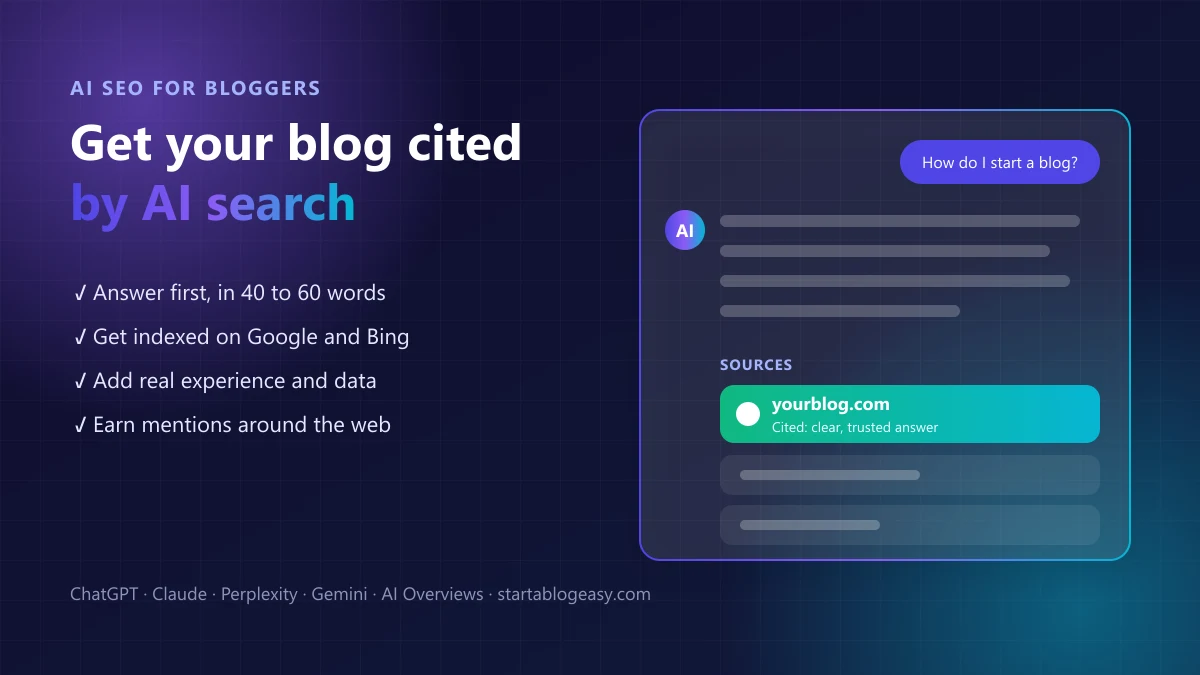
To rank on ChatGPT, Claude and other AI tools, make sure your blog is indexed by Google and Bing, let AI crawlers access it, and write posts that answer specific questions clearly in the first sentence of each section. AI tools don't keep a fixed ranking. When someone asks a question, they search the web and quote the pages that give the clearest, most trustworthy answer. Your job is to be findable and easy to quote.
Millions of people now ask ChatGPT, Claude, Perplexity and Gemini questions they used to type into Google, and Google itself answers many searches with AI Overviews. For bloggers, that's both a threat and a big opportunity: a small blog with a great answer can get cited right next to huge websites. This guide explains how AI search works, what recent research shows, and 10 practical steps to get your blog cited.
Short on time? Do these 4 quick wins today (about 15 minutes):
- Check your robots.txt so AI crawlers aren't blocked (step 1).
- Add your site to Bing Webmaster Tools, because ChatGPT and Copilot rely on Bing (step 2).
- Rewrite the first paragraph of your top 3 posts so it answers the question right away (step 3).
- Ask ChatGPT your main question and see who it cites today (tracking).
How do AI tools decide which websites to show?
AI assistants find information in two ways:
- Training data: What the model learned from the web before its knowledge cutoff. Getting into this takes months and you can't control it directly.
- Live web search: For current or specific questions, the AI runs its own searches, reads the top results and cites the sources it uses. This is where bloggers can win today.
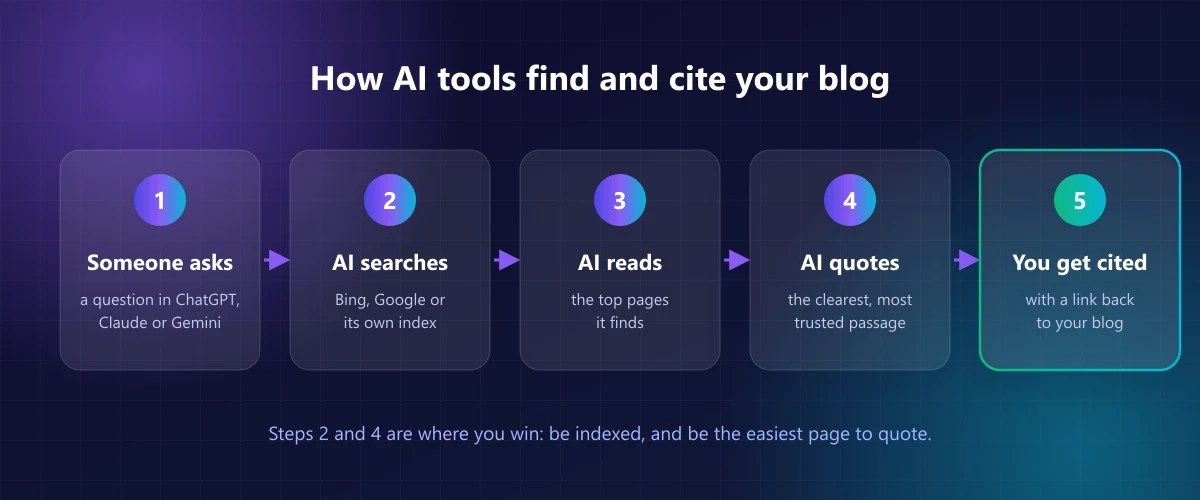
Each AI tool searches a different index, which is why it pays to be visible in more than one search engine:
| AI tool | Where it finds web pages | Crawler to allow |
|---|---|---|
| ChatGPT | Its own crawler plus search partners, including Bing | OAI-SearchBot, GPTBot, ChatGPT-User |
| Claude | Web search through a third-party search provider | ClaudeBot, Claude-SearchBot, Claude-User |
| Perplexity | Its own index plus live searching | PerplexityBot |
| Gemini and Google AI Overviews | Google's search index | Googlebot (Google-Extended controls AI training only) |
| Microsoft Copilot | Bing's search index | Bingbot |
What does the research say gets cited?
Several large studies in 2026 looked at which pages AI tools actually cite. The details vary, but a few patterns show up again and again:
- Google rankings help, but they are not everything. An Ahrefs analysis found that a large share of AI Overview citations come from pages outside Google's top 10 for that search. Clear answers can beat big domains.
- Fresh, first-hand content wins. A 2026 study of over 190,000 AI answers found cited pages tended to be more recently updated, showed more first-hand experience and were easier to extract answers from. Tables noticeably raised the odds of being cited by ChatGPT.
- The answer comes first. Cited pages were far more likely to open with a direct answer than pages that were passed over.
- Your reputation off your site matters. Mentions of a brand on forums, Reddit, review sites and other blogs appear to influence AI visibility strongly, especially on Perplexity.
Keep it in perspective. AI companies don't publish their ranking rules, and many "AI SEO" statistics online come from tool vendors. The steps below focus on what consistently helps across studies and also improves your regular Google SEO.
How to rank on ChatGPT and AI search: 10 steps
1. Make sure AI crawlers can access your blog
If AI tools can't read your pages, they can't cite them. Open yourblog.com/robots.txt and check that you aren't blocking AI crawlers. The simplest safe setup allows everyone:
User-agent: *
Allow: /
Sitemap: https://yourblog.com/sitemap.xml
Also check your hosting and security settings. Some CDNs and security tools, including Cloudflare, can block AI bots by default. If you use one, look for an "AI crawlers" or "bot" setting and make sure search-related AI bots are allowed.
Training vs search bots: Some bots collect data to train AI models (like GPTBot), while others fetch pages to answer live questions (like OAI-SearchBot and Claude-User). If you don't want your content used for training, you can block training bots but still allow search bots, so you can be cited.
2. Get indexed on Google and Bing
Most bloggers only submit their site to Google, but ChatGPT and Copilot rely heavily on Bing. Do both:
- Google: Add your site to Google Search Console and submit your sitemap. Here's our step-by-step guide on how to submit your blog to Google.
- Bing: Sign up for Bing Webmaster Tools. You can import your site straight from Google Search Console in a couple of clicks, then submit your sitemap.
- IndexNow: Many SEO plugins and hosts support IndexNow, which tells Bing and other engines about new and updated posts instantly.
3. Answer the question in the first 40 to 60 words
AI tools quote passages, not whole pages. The easiest passage to quote is a short, complete answer right under a heading. For every important section:
- Start with a 1 to 3 sentence answer (about 40 to 60 words) that makes sense on its own.
- Then add the details, steps and examples.
- Avoid long warm-up intros like "In today's digital world...".
Here's the difference for a post titled "How much does it cost to start a blog?":
❌ Hard for AI to quote
"Starting a blog is an exciting journey that many people dream about. In today's digital world, there are countless options, and the cost can vary depending on many factors. In this article, we'll explore everything you need to know..."
No answer, no numbers, and nothing an AI can lift as a complete reply.
✅ Easy for AI to quote
"Starting a blog costs about $50 to $150 for the first year, covering hosting and a domain. You can start free, but paid hosting gives you full ownership and more ways to make money."
A full answer in 2 sentences, with specific numbers and a clear recommendation.
4. Use question headings, lists and tables
Structure helps AI tools understand and lift your content:
- Write headings as questions people actually ask: "Is Wix good for blogging?" or "How long should a blog post be?"
- Use numbered steps for processes and bullet lists for options.
- Add comparison tables for prices, features and pros and cons. Tables are especially easy for AI to quote.
- Add an FAQ section at the end that answers related questions in 2 to 4 sentences each.
5. Add first-hand experience and original information
AI tools see the same generic advice on thousands of sites. What makes your page worth citing is what only you can add:
- Results from your own tests ("I tried 5 AI website builders, and here's what happened").
- Real numbers: your traffic, income, costs or timelines.
- Your own photos and screenshots.
- Clear opinions and recommendations, with reasons.
This is also exactly what Google looks for in helpful content (often called E-E-A-T: experience, expertise, authoritativeness and trust).
6. Cite your sources and use specific facts
Vague claims are hard to trust and hard to quote. Specific, sourced facts are easy for AI to reuse. Write "WordPress powers over 40% of all websites" instead of "WordPress is very popular", and link to the original source when you use someone else's data.
7. Keep your posts fresh
AI tools prefer up-to-date information, especially for prices, tools and "best of" lists. Review your important posts every few months, update outdated details, show an "updated" date, and include the current year in titles where it makes sense, like "Best Blogging Platform in 2027".
8. Build mentions beyond your own blog
AI tools learn which brands to trust from what the rest of the web says. Get your blog mentioned in places AI tools read often:
- Reddit and forums: Answer questions helpfully in your niche. Only link to your blog when it truly helps.
- YouTube: Videos and their transcripts are widely used as sources.
- Guest posts and interviews on other blogs and podcasts in your niche.
- Quora, Medium and LinkedIn articles that summarize your best ideas.
- Consistent branding: Use the same blog name and description everywhere so AI tools connect the mentions to you.
9. Add structured data and an llms.txt file
Structured data (schema markup) tells search engines exactly what's on your page: an article, an author, an FAQ, a how-to. SEO plugins like Yoast or Rank Math add the basics automatically on WordPress, and Wix adds them for you. The research on whether schema directly affects AI citations is mixed, but it helps Google understand your pages, which feeds Gemini and AI Overviews.
An llms.txt file is a newer, optional plain-text summary of your site written for AI tools. It takes minutes to add. Just don't expect miracles: there's no public confirmation that the major AI tools rely on it yet.
10. Build topic clusters with internal links
AI tools and Google both trust sites that cover a topic in depth. Instead of one-off posts, create a group of related posts around each main topic and link them together. For example, a "start a blog" cluster could include blog name ideas, how long a blog post should be and how to drive traffic to your blog, all linked to each other and to one main guide.
How to check if AI tools cite your blog
There's no "AI Search Console" that covers every tool yet, but you can track it in three ways:
- Ask the AI tools directly. Every month, ask ChatGPT, Claude, Perplexity and Gemini the main questions your posts answer and note whether your blog is cited.
- Check your analytics. In Google Analytics, look at referral traffic from
chatgpt.com,perplexity.ai,claude.ai,gemini.google.comandcopilot.microsoft.com. - Watch Google Search Console. Clicks from AI Overviews and AI Mode are included in your search performance data.
Use this prompt to quickly check your visibility:
I run a blog about [topic] called [blog name] at [your URL]. Search the web and answer: what are the best resources for [main question your blog answers]? List the websites you would cite. Then tell me whether my blog appears, and if not, what my best post on this topic is missing compared to the sources you chose.
AI SEO myths to ignore
- "SEO is dead." AI tools rely on search indexes to find pages. Good SEO is the foundation of AI visibility.
- "You need special AI-written content." AI tools cite helpful, human-sounding content with real experience. Generic AI text is exactly what they skip.
- "Stuff your post with keywords." AI tools understand meaning. Clear answers beat repeated phrases.
- "Only big sites get cited." AI tools cite specific passages, so a small blog with the best answer to a narrow question can win.
- "There's a trick to get guaranteed rankings." Nobody can guarantee citations. Be wary of any service that promises them.
How we optimize this blog for AI search
We use these steps on Start a Blog Easy. Every guide opens with a direct answer, uses question headings and comparison tables, ends with an FAQ, and shows its "updated" date. Our robots.txt allows search and AI crawlers, we publish a sitemap and an llms.txt file, and each article includes structured data for the article, its author and its FAQ. You can see the approach in action in our guides on how to start a blog on Wix and the best blogging platforms.
Next steps
You don't need to do everything at once. Start with the quick wins: check your robots.txt, submit your site to Bing, and rewrite the first paragraph of your top 5 posts so they answer the question immediately. Then keep publishing helpful, experience-based posts.
- Use AI to help you write faster (without sounding generic): how to write a blog post with AI
- See which AI assistant fits your blogging workflow: ChatGPT vs Claude vs Gemini
- Get more visitors from every source: how to drive traffic to your blog
- Don't have a blog yet? Start one with our free step-by-step guide
Frequently asked questions
How do I get my blog to show up in ChatGPT?
Make sure your blog is indexed by Bing and Google, allow OpenAI's crawlers (OAI-SearchBot and GPTBot) in your robots.txt, and write posts that answer specific questions directly in the first sentences of each section. ChatGPT searches the web for current questions and cites pages that give clear, trustworthy, easy-to-quote answers.
What is generative engine optimization (GEO)?
Generative engine optimization, also called GEO, AEO (answer engine optimization) or LLM SEO, means optimizing your content so AI tools like ChatGPT, Claude, Perplexity, Gemini and Google AI Overviews mention and cite it in their answers. It builds on regular SEO rather than replacing it.
Is ranking on ChatGPT different from ranking on Google?
Partly. Both reward helpful, trustworthy content and both need your pages to be indexed. The difference is that AI tools quote short passages instead of listing ten links, so clear direct answers, structure and mentions of your brand around the web matter more. Studies in 2026 found many AI-cited pages are not in the Google top 10 for the same query.
Can a new or small blog get cited by AI?
Yes. Because AI tools cite specific passages, a small blog with a clear, original answer to a narrow question can be cited next to much bigger sites. Focus on specific questions in your niche and add first-hand experience that big sites don't have.
Do I need an llms.txt file?
It is optional. An llms.txt file is a plain-text summary of your site for AI tools. It is quick to add and does no harm, but there is no public confirmation that major AI tools like ChatGPT or Google rely on it, so focus on content and indexing first.
How long does it take to get cited by AI tools?
Tools that search the web live, like Perplexity and ChatGPT search, can cite a new page within days of it being indexed. Google AI Overviews usually take longer, often several weeks. Being included in an AI model's built-in knowledge can take months, because it depends on when the model is next trained.
How do I know if ChatGPT is sending traffic to my blog?
In Google Analytics, check referral traffic from sources like chatgpt.com, perplexity.ai, claude.ai and gemini.google.com. You can also ask each AI tool the questions your posts answer and see whether your blog is cited.